Bora Praia
Your Beach Plan Shouldn’t Expire While You’re Packing the Bag
Bora Praia now keeps Today’s top three Perfect Timing options aligned with beach-local time—without abandoning the departure you already planned around.

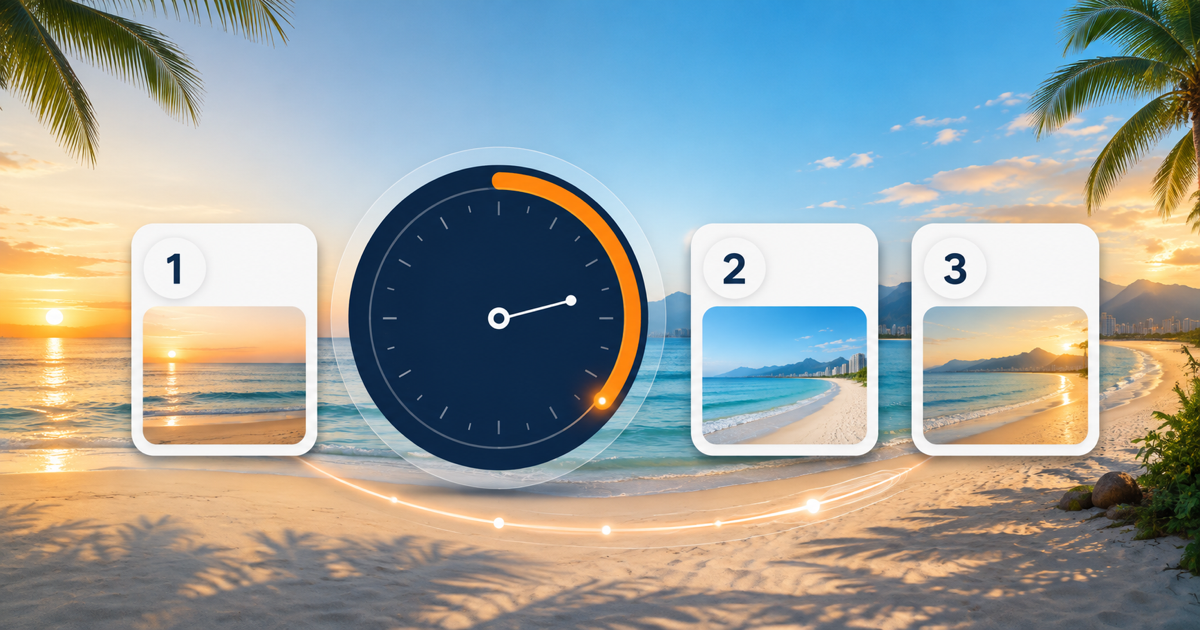
The best time to leave for the beach should move with the day—not vanish the moment real life makes you late.
On September 13, people around the world will take part in the 2026 Blue Dragon Walk, choosing anything from a gentle meander to a full marathon. Here in Da Nang, the city’s official event calendar lists a September charity walk along the Bắc Mỹ An–Mỹ Khê beachfront. (Blue Dragon Children’s Foundation; Da Nang Tourism Promotion Center)
An organized walk and a spontaneous beach trip are very different outings. But they share a deceptively difficult product question: what should a plan do when the clock keeps moving?
That question led to a small but important update in Bora Praia. Perfect Timing now remains actionable throughout Today, even when the person following it is still packing a bag, getting children ready, looking for the keys, or already travelling toward the coast.

A recommendation can be correct and still fail the person
Imagine opening Bora Praia at 7:15 in the morning. The best match for your routine says to leave at 8:00. You make coffee, find the sunscreen, pack water, and discover that one sandal has disappeared into whatever dimension keeps unmatched socks.
At 8:03, you reopen the app.
A rigid system has two unsatisfying choices. It can keep showing 8:00 as if time stopped, which is stale. Or it can immediately remove the recommendation, which makes the plan feel as though it has been cancelled for being three minutes late.
Both behaviours optimize for the clock instead of the outing.
The old shape of Today’s ranking made this tension more visible. A fixed morning evaluation could grow stale as the day advanced. If the useful candidate pool was treated too narrowly, strong later options could be absent. And an originally recommended departure could disappear precisely when someone was trying to act on it.
Forecast software often treats the current time as a filter. People experience it as momentum. Once breakfast, bags, transport, and other people are involved, a departure time becomes a commitment—not just a row in a ranking.
Today is now evaluated as a moving horizon
For Today, Bora Praia now evaluates the full daylight candidate pool before selecting the top three Perfect Timing options. As the day advances, those candidates stay aligned with the time at the beach itself.
That beach-local detail matters. A person may be planning from another city, travelling across a timezone, or simply looking at a place whose daylight and tide cycle should not be interpreted through the phone’s current location. “Today” belongs to the destination.
The result is a recommendation set that behaves more like the day it represents:
- The whole useful day is considered. Today’s ranking starts from the full daylight candidate pool, so the app can keep surfacing viable later windows instead of acting as though morning was the only chance.
- The top three move with beach-local time. Options that are genuinely behind the user can make way for candidates that can still be acted on.
- The original plan gets breathing room. An originally suggested departure receives a one-hour grace period instead of disappearing the instant its minute passes.
- Future plans stay calm. Dates after Today keep their existing behaviour because a future recommendation does not need to chase the current clock.
This is not about pretending that 8:00 is still in the future at 8:40. It is about recognizing that someone who planned around 8:00 may already be on the way. For that person, the recommendation still explains the outing they chose and remains useful context for the visit ahead.
One hour of grace is a product decision, not a weather claim
The grace period does not say conditions will remain identical for an hour. It does not overrule a changing forecast, an official warning, a beach closure, or local safety guidance.
It solves a continuity problem.
Without grace, a plan can blink out at the exact boundary between “getting ready” and “running late.” With unlimited grace, an old suggestion could linger long after it stopped being relevant. One hour creates a bounded handoff: enough time for an original plan to survive ordinary delay, but not permission for it to remain forever.
That balance is important because a planning product has two responsibilities. It should reflect the world as it changes, and it should respect the choice the user already made. Good real-time software needs both.
Refresh when attention returns
Bora Praia now reassesses Today when you open the app, resume it, or pull to refresh. Those are the moments when attention returns and a person is most likely to ask, “What is my best option now?”
There is no extra network request solely because the clock advances. The new time can change which already-available candidates remain actionable, but it is not, by itself, a reason to contact the network again.
That distinction keeps the behaviour proportional. The interface stays current at meaningful moments without treating every passing minute as a demand for more data.
Stable does not mean frozen
There is a subtle difference between a stable recommendation and a static one.
A static ranking ignores new context. A stable experience updates the context without making the user feel that the product has forgotten the decision it helped them make.
The top three provide alternatives as Today moves forward. The one-hour grace period protects continuity around the original choice. Beach-local time keeps the comparison honest. Together, those rules reduce stale suggestions while avoiding a twitchy interface that needlessly punishes a late start.
This is the part of recommendation design that rarely fits in a screenshot. The value is not just identifying the mathematically strongest moment. It is carrying that advice across the messy minutes between deciding and doing.
A better answer to “Should we still go?”
Before leaving for the beach, people do not need a product to scold them with an expired timestamp. They need to know whether their plan still makes sense—and, if it does not, what the next good option is.
That is what this update changes for Bora Praia users. Perfect Timing can keep an original departure visible long enough to remain recognizable, refresh the top three against the beach’s own clock, and continue through the rest of the daylight candidates when the first plan is truly behind you.
For someone comparing beaches from home, that means fewer stale suggestions. For someone already preparing, it means the recommendation is less likely to disappear mid-routine. For someone on the road, it means the app can still respect the plan that set the trip in motion.
The outcome is simple: Perfect Timing remains actionable throughout the day while respecting the user’s original plan.